
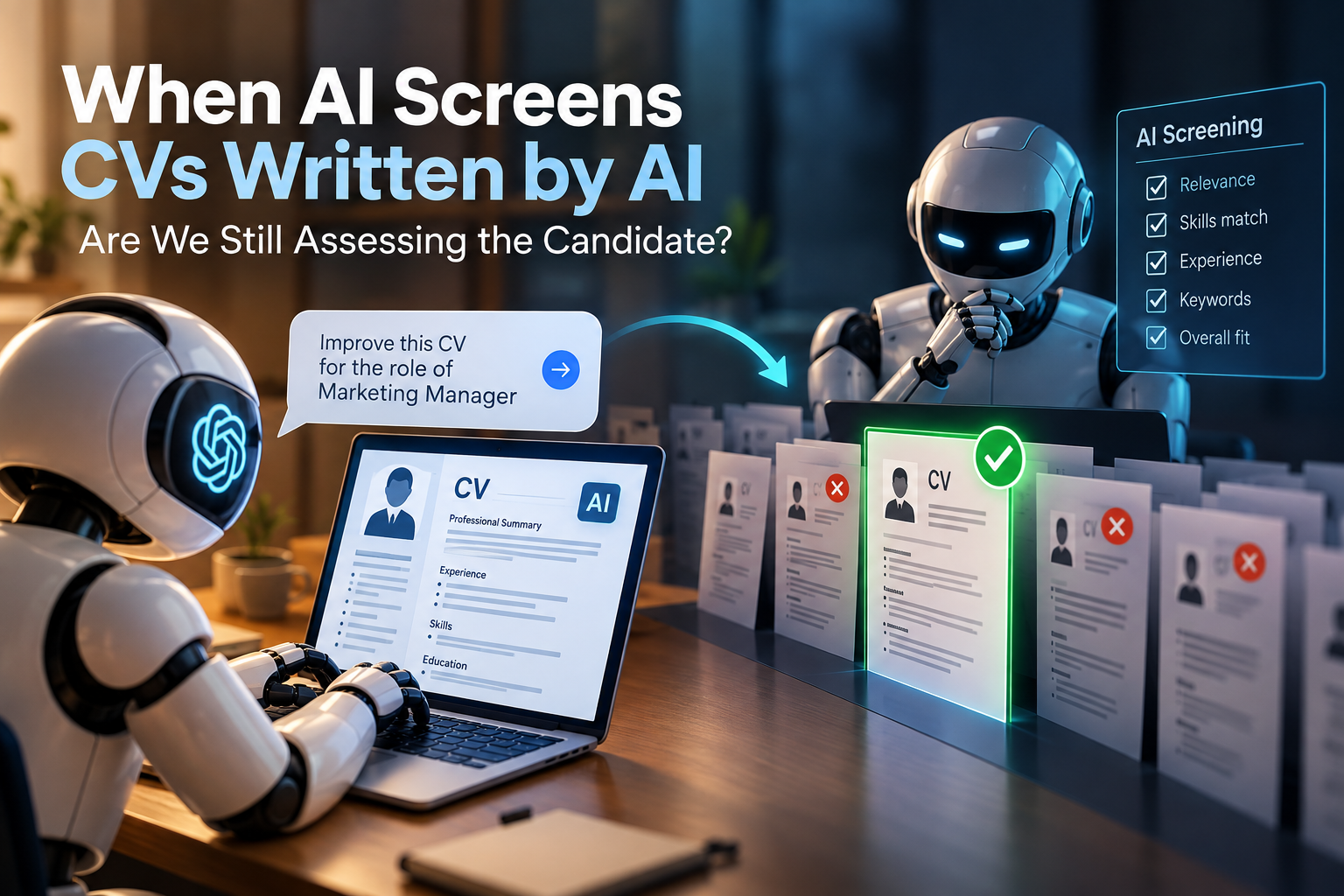
Artificial Intelligence is rapidly becoming part of recruitment.
Candidates use AI to improve their CVs, rewrite their professional achievements, tailor applications to specific job descriptions and prepare for interviews. At the same time, recruiters and organizations increasingly use AI-powered tools to screen CVs, identify relevant profiles and support shortlisting decisions.
This creates an interesting paradox: AI is increasingly evaluating CVs that may themselves have been written or optimised by AI.
So what exactly are we assessing? The candidate — or how effectively their application has been optimised?
A great CV does not necessarily mean a great candidate
A candidate can provide an AI tool with a job description and their professional background and, within seconds, generate a polished CV containing the right terminology, relevant keywords and achievements framed specifically for that position.
Another candidate — potentially just as capable, or even better suited to the role — may submit a less sophisticated CV.
If another AI system then compares those applications and identifies the apparently stronger match, there is a risk that we are partly measuring the quality and optimisation of the document rather than the actual potential of the person behind it.
The problem is not that candidates use AI.
Using available technology to present one's experience more effectively is perfectly understandable.
The problem arises when organisations treat the CV as sufficient evidence of a candidate's suitability.
A CV is a source of information. It is not an assessment.
CVs remain extremely valuable. They provide information about professional experience, education, qualifications, career progression and technical exposure. But many factors that influence performance cannot be reliably determined from a CV alone.
How does the candidate analyse a complex situation?
How do they prioritise?
How do they make decisions under pressure?
How do they communicate with a difficult stakeholder?
What is their behavioural profile?
How closely does their profile match the requirements of the role?
What happens when they are placed in a realistic business situation?
These are fundamentally different questions. And this is where structured assessment becomes valuable.
From what candidates say to what they can demonstrate
A well-designed assessment process adds another layer of evidence to recruitment.
Depending on the role, organisations can combine psychometric assessments with structured interviews and business simulations such as In-Basket exercises, Role Plays, Analysis & Presentation exercises or a complete Assessment Centre.
Instead of relying exclusively on how candidates describe themselves, we can observe how they approach situations relevant to the job.
Consider a management candidate whose CV states that they have "excellent prioritization and decision-making skills." Rather than simply accepting the statement, an In-Basket exercise can place that person in a realistic managerial scenario containing competing priorities, incomplete information, operational problems and stakeholder requests.
We can then observe what the candidate actually does.
Suddenly, we have more than a well-written statement.
We have observable behaviour and structured assessment data.
Assessment does not replace human judgement
This distinction is important. Neither a psychometric assessment nor an Assessment Centre should become an automated oracle that decides who gets hired. The purpose of professional assessment is to provide additional, comparable and job-relevant evidence that complements professional experience, interviews and other information available during the selection process.
The final decision remains a human decision. But it can be a better-informed one. A CV is designed to present a candidate as effectively as possible. A professional assessment process is designed to measure characteristics and behaviours relevant to performance in a specific role. Those are two very different objectives.
AI may actually make assessment more important
As generative AI improves, CVs, cover letters and interview preparation will inevitably become more sophisticated.
That is not necessarily a bad thing. But it does mean organisations need to become increasingly aware of the difference between presentation and potential — between what candidates can claim and what they can demonstrate.
AI can bring enormous value to recruitment. It can process information, reduce administrative work and help recruiters manage large candidate pools. The mistake would be to assume that better technology for analysing applications automatically gives us better evidence about the people behind those applications. For important roles, recruitment decisions deserve multiple sources of evidence. Perhaps the question organisations should increasingly ask is no longer:
“Who has the best CV?”
but rather:
“Who can demonstrate the competencies and potential required to succeed in this role?”
In an age where AI can write the application and another AI can read it, structured assessment provides something increasingly valuable: evidence beyond the CV.